

If you’ve moved from Australia to the UK, recent changes to Australia’s Capital Gains Tax (CGT) rules may not seem immediately relevant as you are now living and paying tax in the UK.
However, if you still hold investments, property, or other assets in Australia, the changes announced in the 2026 Australian Federal Budget could have implications for your financial planning – particularly if you’re considering selling assets or returning to Australia in the future.
While the proposed changes are not due to take effect until 1 July 2027, understanding how they may affect your position now can help you make more informed decisions in the future.
The current 50% Capital Gains Tax discount will be replaced with an inflation-based discount
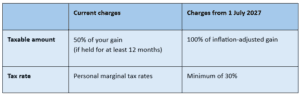
Currently, Australian residents can generally receive a 50% CGT discount when they have held an eligible asset for at least 12 months.
However, from 1 July 2027, the government plans to replace this discount with an inflation-adjusted approach. The cost base of an asset will be indexed for inflation. This effectively means that only the real, above-inflation gain will be subject to tax.
A minimum tax rate of 30% will also apply to real capital gains accruing from 1 July 2027. The changes are prospective, with gains accruing before that date retaining access to the existing 50% discount.
While the changes are significant, they don’t necessarily mean every investor will pay more tax. The outcome will depend on a series of factors including the asset, how long you’ve held it, the inflation rate, and the investment return.
Find out more: How proposed changes to Capital Gains Tax could affect you, and what you should do about them
Considering your retained Australian assets
While gains you may enjoy on UK-based investments are not subject to Australian CGT, you may still own an Australian investment property, shares, or other assets that could eventually be sold.
As a result, you will need to consider how these changes could affect you.
For example, as a non-resident, you must pay Australian CGT when you sell direct interests in Australian real estate or land, or indirect Australian real property-holding entities.
If you have retained an Australian share portfolio, the position can be more complicated than simply paying CGT when you eventually sell.
Australia’s rules can treat certain assets as having been disposed of when you cease Australian tax residency, potentially creating a CGT liability even though no shares have actually been sold.
Furthermore, you may have chosen to defer deemed disposal, which means the Australian CGT liability is generally considered when you eventually dispose of the shares.
As a result, it’s important to review all your retained assets in Australia and assess how the changes from 1 July 2027 could affect you.
Should you sell before the changes?
The proposed changes may naturally prompt you to consider Australian-held assets before the new rules take effect.
However, the tax liability should not be the only consideration.
Selling an asset based in Australia could trigger a significant capital gain, transaction costs, and potentially a UK tax liability. You may also be giving up an investment that still fits your long-term objectives.
Conversely, retaining an asset to avoid crystallising a gain could leave you holding an investment that no longer suits your circumstances or overall financial strategy.
Rather than making decisions based solely on the proposed Australian CGT changes, it can be more appropriate to take a holistic view of your finances.
Consider your Australian property, investments, superannuation and other assets alongside your UK pensions, investments, income and future retirement plans.
The right decision depends on your individual circumstances and the role each asset plays in your wider financial plan.
Consider your wider financial plan
As an Australian expat living in the UK, the proposed CGT changes should form part of your wider cross-border financial planning rather than being considered in isolation.
Before deciding whether to sell, retain or restructure an Australian asset, it is important to consider the potential Australian and UK tax consequences alongside your investment objectives, currency exposure and longer-term plans.
It is also important to consider how your Australian assets fit alongside your UK-based wealth. For example, selling an Australian investment may alter your exposure to the Australian dollar, while retaining it could leave a significant proportion of your wealth tied to the Australian economy.
With the proposed changes not taking effect until 1 July 2027, there is time to review your position and consider your options carefully.
Get in touch
At bdhSterling, we help Australians living in the UK make informed decisions about financial planning and cross-border wealth management.
With advisers based in both the UK and Australia, we’re uniquely positioned to help you build a financial strategy that works regardless of where you are living.
If you’d like to discuss your own circumstances, we’d be happy to help.
Get in touch to find out how we can help you.
Please note
The value of your investment can go down as well as up, and you may not get back the full amount you invested. Past performance is not a reliable indicator of future performance.
This article is for information only; it does not take into account your personal objectives, financial situation, or needs.
Please do not solely rely on anything you have read in this article and ensure that you conduct your own research to ensure any actions you may take are suitable for your circumstances.
All contents are based on our understanding of HMRC and ATO legislation, which is subject to change.