

For Australian expats living in the UK, your financial interests may now span two countries.
You may have Australian shares, a superannuation fund, and perhaps property back home, while your income, spending and financial future are increasingly linked to the UK.
You may also have invested in Australian companies simply because they were familiar to you when you lived there. Now that you’re living in the UK, it can be equally tempting to invest heavily in UK companies and assets because they are closer to home.
However, concentrating too much of your portfolio in either country could leave you with a portfolio that is overly exposed to one region.
This tendency to favour investments in the country, or countries, you know best is called “home bias”, and it can significantly affect your investment strategy.
The temptation is to invest in what you know
It is common to invest in companies and markets you are familiar with and recognise, because there is comfort in sticking to what you know.
Research from Dimensional (a globally respected investment firm and one of our trusted fund management partners, whose strategies many of our clients invest in) highlights the scale of this issue. Australian-listed companies represent only about 2% of global equity market capitalisation, yet Australian investors can hold a much larger proportion of their portfolios in domestic shares.
This means they may have limited exposure to the other 98% of the world’s more than $120 trillion equity market.
Moving to the UK does not necessarily mean you have to leave your Australian finances behind. Your superannuation portfolio may include Australian assets, while Australian shares can provide exposure to important sectors such as banking and resources.
The risk arises when these holdings become concentrated simply because they are familiar.
If a significant proportion of your wealth is already tied to Australia, continuing to add Australian investments could increase rather than reduce your overall concentration.
Equally, moving to the UK can create a different form of home bias. As your life becomes increasingly UK-based, you may naturally start investing predominantly in UK companies and assets. You could hold UK equities, property and cash, while your employment income and future pension benefits are also linked to the UK economy.
This can create another layer of concentration. According to Dimensional, UK stocks account for just over 3% of the global stock market, and they reflect this in their World Equity Fund allocation.
Limiting your investments primarily to the country where you currently live, or the country you know best, can mean missing opportunities across the much wider global investment universe.
Look beyond the country you live in
Diversification is about spreading risk across different regions, sectors, companies, and asset classes.
International investments can provide exposure to areas that are less prominent in either Australia or the UK.
For example, global markets offer greater exposure to sectors such as technology and healthcare, while investing across different economies means your portfolio is not entirely dependent on one country’s economic fortunes.
Perhaps more importantly, no single market consistently outperforms year after year. Countries and regions regularly move between the top and bottom of the performance rankings, making it extremely difficult to predict where the strongest returns will come from next.
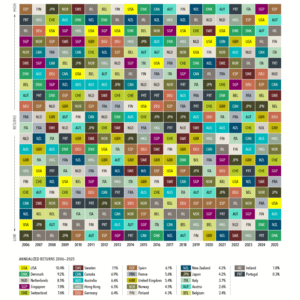
The chart below, showing comparative annual returns over the last 20 years, illustrates this point. Over the past 20 years, the scattered colours show how leadership among developed markets has shifted repeatedly, with last year’s best-performing market often falling well down the rankings in subsequent years.
Source: Dimensional
This unpredictability is one of the strongest arguments for maintaining a globally diversified portfolio rather than concentrating investments in familiar markets.
That does not mean abandoning Australian or UK investments. It means making sure they form a proportionate part of a deliberate strategy rather than dominating your portfolio simply because they feel familiar.
Find out more: Why your cross-border investment strategy should involve investing in all sectors, not just one
Look at your wealth as a whole
Avoiding home bias does not necessarily mean starting to invest again from scratch. Nor should it entail looking at your investment portfolio in isolation.
Instead of viewing investments in isolation, consider the bigger picture. This includes your Australian superannuation, Australian property, UK pension, UK investments, cash, employment income and any future inheritance or other significant assets. Then look at the countries and currencies each is exposed to.
You may discover that a portfolio that appears well diversified is actually heavily concentrated in the UK and Australia when your wider wealth is taken into account.
A globally diversified investment strategy can help you retain appropriate exposure to both countries while also accessing a much wider range of markets, sectors, and investment opportunities.
Get in touch
Expert advice and regular reviews of your investment strategy can help ensure that you are best positioned to achieve your long-term goals.
At bdhSterling, we specialise in helping clients navigate the complexities of international financial planning. Whether you’re managing assets in multiple countries or planning a move abroad, our expert advisers can help you build a resilient, long-term investment strategy.
Get in touch to find out how we can help you.
Please note
The value of your investment can go down as well as up, and you may not get back the full amount you invested. Past performance is not a reliable indicator of future performance.
This article is for information only, it does not take into account your personal objectives, financial situation, or needs. Please do not solely rely on anything you have read in this article and ensure that you conduct your own research to ensure any actions you may take are suitable for your circumstances.
All contents are based on our understanding of HMRC and ATO legislation, which is subject to change.