

If you’re an Australian expat living and working in the UK, buying a property could be an exciting and significant milestone for you.
Whether you’re planning to stay for a few years or have decided to make the UK your long-term home, owning property could create a greater sense of stability and help build your wealth over time.
However, buying property as an expat isn’t straightforward, and various factors can affect your purchase.
Here are some key pointers to consider before deciding to buy a home in the UK.
Ensure owning UK property aligns with your plans
Before viewing properties or applying for a mortgage, it’s worth having an idea of how doing so fits in with your longer-term objectives.
If you intend to remain in the UK indefinitely, buying a home may provide long-term security while allowing you to benefit from any future growth in property values.
However, if your move to the UK is likely to be temporary, purchasing property may not always be the most suitable option.
Selling costs, property market fluctuations, and exchange rate movements can all affect the overall return on your investment, particularly if you expect to relocate within a relatively short period.
Understanding your long-term objectives will help shape many of the financial decisions that follow.
Get a clear idea of the mortgage options available to you as an expat
As an Australian, you can often obtain mortgages from UK lenders, particularly if you have stable employment, a regular income, and a good UK credit history.
However, every lender has different criteria regarding residency status, visa arrangements, and employment circumstances.
Some may require longer periods of UK residency than others, and if you are self-employed, you may need to provide additional financial information.
A deposit of 15% to 25% is common for expats, although the exact amount will depend on factors such as:
- Income and employment details
- Your residency status
- The lender’s own criteria.
The larger your deposit, the wider your choice of mortgage products and the more competitive the interest rates available to you are likely to be.
It’s worth getting a “mortgage agreement in principle” before starting your property search. This will give you a clear understanding of how much you can borrow and demonstrate to sellers that you are a serious buyer.
Once you’ve established how much you can borrow, it’s important to understand the additional costs of buying a home, particularly taxes and transaction costs.
Understand your Stamp Duty Land Tax liability
If you’re an Australian expat buying property in England or Northern Ireland, Stamp Duty Land Tax (SDLT) is likely to be one of your highest upfront costs.
The amount you pay will depend on the purchase price, whether you already own other residential property anywhere in the world, and your UK residency status for SDLT purposes.
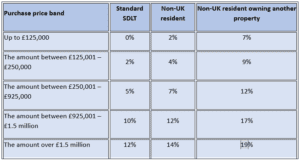
For example, if you are buying a property for £500,000, the standard SDLT charge as a UK resident you would owe would be calculated as follows:
- 0% on the first £125,000 = £0
- 2% on the second £125,000 = £2,500
- 5% on the final £250,000 = £12,500
- total SDLT = £14,500
The 2% non-UK resident surcharge can sometimes be reclaimed if you subsequently meet the UK residence test within the permitted time frame, which is usually two years from the date of purchase.
Similarly, you may be able to reclaim the 5% surcharge if you owned a property in Australia and subsequently sell it within three years of purchasing in the UK.
In addition to your deposit and SDLT, other costs will include legal fees, surveys, mortgage arrangement fees, and removal costs.
Having a clear understanding of the costs before you begin your property search can help you avoid unnecessary financial pressure later.
Think about currency risk
If you are transferring funds from Australia to help purchase a UK property, exchange rate movements can significantly affect the value of your savings in sterling terms. Even relatively small currency fluctuations can affect the size of your deposit or overall purchasing budget.
Likewise, if you expect to sell the property and return to Australia in the future, exchange rates may influence the value of your proceeds once converted back into Australian dollars.
While currency movements cannot be predicted, they should be recognised as part of your overall financial planning.
Find out more: Why expats in the UK and Australia need to take currency risk seriously
Don’t overlook protection
Buying a property is usually the largest financial commitment most people will ever make.
It’s therefore sensible to consider how you and your family would cope if illness, injury, or loss of income affected your ability to meet mortgage repayments.
Appropriate life insurance, income protection, and, where suitable, critical illness cover can provide valuable financial security and help ensure your home remains protected should your circumstances change unexpectedly.
Make your property part of a wider financial plan
Buying a home can be an excellent long-term investment. However, it’s worth considering how your property purchase fits alongside other important aspects of your financial plan.
A balanced financial plan considers your property alongside your pensions, investments, tax planning, and retirement objectives, helping to ensure that all aspects of your wealth work together.
This becomes important if your circumstances change, particularly if you plan to return to Australia.
At bdhSterling, we help Australians living in the UK make informed decisions about financial planning and cross-border wealth management.
With advisers based in both the UK and Australia, we’re uniquely positioned to help you build a financial strategy that works wherever life takes you.
Get in touch to find out how we can help you.
Please note
The value of your investment can go down as well as up and you may not get back the full amount you invested. Past performance is not a reliable indicator of future performance.
This article is for information only, it does not take into account your personal objectives, financial situation, or needs.
Please do not solely rely on anything you have read in this article and ensure that you conduct your own research to ensure any actions you may take are suitable for your circumstances.
All content is based on our understanding of HMRC and ATO legislation, which is subject to change.