

Superannuation, or simply “super”, is Australia’s retirement savings system and plays a central role in helping Australians build wealth for retirement.
If you’ve recently moved from the UK to Australia, or are planning to, you’ve probably already heard about super. Although it shares many similarities with the UK pension system, there are several important differences in how contributions are made, how benefits are taxed, and the choices available to members.
For many UK expats, understanding how the Australian superannuation system works, and how it compares with the UK pension system, can help you make more informed financial decisions and ensure your long-term retirement plans remain on track.
The foundation of the super system is compulsory employer contributions
Australia’s superannuation system was introduced in 1992 with the launch of the compulsory Superannuation Guarantee, which requires employers to make contributions to employees’ retirement savings.
Unlike the UK workplace pension system, the Superannuation Guarantee is considerably higher than minimum employer contributions in the UK. As a result, many British expats find their retirement savings grow more quickly than they initially expected during their time in Australia.
Since then, compulsory contribution rates have gradually increased from 3% to the current 12% (2026/27). Today, it is one of the world’s largest pension systems, with over AUD$4 trillion under management (Source: APRA).
The size and strength of superannuation has prompted Deutsche Bank to describe the system as a “global powerhouse” in worldwide pension funds.
You can make your own super contributions
In addition to compulsory employer contributions, you can boost your super through voluntary contributions:
- Concessional contributions are made from your pre-tax income, which are taxed at a concessional rate within the fund.
- Non-concessional contributions are made from your after-tax income and do not receive a tax deduction.
You also have the option to set up your own super arrangement known as a Self-Managed Super Fund (SMSF). These allow you to invest in a wider range of funds and give you greater control over your retirement planning. Against these advantages, however, you should be aware that SMSFs have onerous reporting and regulatory requirements. In addition, small SMSF balances can be costly when compared to equivalent-sized retail funds.
Comparing the UK and Australian pension systems
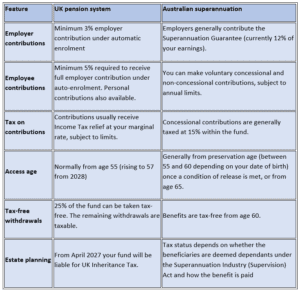
At first glance, superannuation looks similar to a UK defined contribution (DC) pension.
Both involve investing contributions over many years, and both benefit from favourable tax treatment.
However, although both systems are designed to fund retirement, they operate under very different tax and legislative frameworks.
This table outlines some of the important differences.
Once you’ve built retirement savings in both countries, it’s important to understand how they interact, the tax consequences of future withdrawals, and how they fit into your overall retirement strategy.
Invest your superannuation wisely
It’s important to treat your super fund as a long-term investment opportunity rather than simply a retirement savings account.
The long-term value will depend not only on how much is contributed, but also on how those contributions are invested over time.
While employer default funds can be suitable for some people, they are designed to meet the needs of a broad range of members rather than your individual circumstances.
Taking an active interest in how your super is invested can make a significant difference to the retirement income it ultimately provides. Most super funds offer a variety of investment options, ranging from low-risk portfolios focused on preserving capital to higher-growth strategies with greater exposure to shares and other growth assets.
Don’t lose track of multiple super funds
You may well end up with multiple super accounts during your time in Australia, including different employer arrangements and any SMSFs you set up.
Each account may carry separate administration fees and insurance premiums, which can gradually erode your retirement savings.
It’s worth reviewing whether consolidating your super funds into a single arrangement makes sense. However, before doing so, it’s important to check whether you would lose valuable insurance benefits or other features attached to an existing fund.
Returning to the UK
There is no automatic requirement to transfer or close your Australian superannuation if you do return to the UK. You can generally leave your super invested in Australia, although being a UK resident is likely to create tax and reporting considerations.
Be aware, however, that if you have set up an SMSF during your time in Australia, you must meet certain residency conditions for it to remain compliant with Australian tax law. One of these is that the fund’s management and control must be based in Australia.
If you depart Australia with no intention of returning, your SMSF will have a two-year grace period before it risks becoming non-compliant. A non-compliant SMSF may be subject to significant tax penalties, so it is essential to plan ahead.
You can extend your fund’s compliant status beyond the two-year period by setting up an Enduring Power of Attorney (EPA), which allows someone you trust to manage and oversee your SMSF on your behalf while you are overseas, helping the fund continue to meet its residency requirements.
We strongly recommend seeking specialist advice before departing Australia to ensure your SMSF remains in good standing, and that you make the right decisions with regards to your super arrangements.
Find out more: 6 key takeaways from our webinar about accessing your super from the UK
8 key facts about accessing your super in the UK
Expert advice can help you make the most of your super funds
As a UK expat, you’ll find that superannuation is probably only going to be one part of your retirement planning.
You are likely to have UK-based pension arrangements and other assets that need to be considered alongside your Australian retirement savings.
Cross-border financial planning can be particularly complex. As you have read here, the UK and Australia have different pension rules and retirement legislation. This means that whether you’re planning to remain in Australia permanently, return to the UK, or keep your options open, it’s important that your financial arrangements are designed with both jurisdictions in mind.
Australian superannuation can be an incredibly valuable retirement asset, but understanding how it fits alongside UK pensions, investments and future plans isn’t always straightforward.
Whether you expect to remain in Australia, return to the UK, or divide your future between the two countries, taking a joined-up approach to retirement planning can help ensure your savings continue to support your long-term goals.
At bdhSterling, our advisers work across both the UK and Australia, helping clients navigate the complex decisions that arise when pensions, tax rules and financial objectives span two jurisdictions.
If you’d like to discuss your own situation, we’d be happy to help.
Find out more: What to do with your Australian super if you live in the UK
Get in touch
If you have any queries regarding your financial planning, please get in touch with us.
Please note
The value of your investment can go down as well as up and you may not get back the full amount you invested. Past performance is not a reliable indicator of future performance.
This article is for information only, it does not take into account your personal objectives, financial situation, or needs.
Please do not solely rely on anything you have read in this article and ensure that you conduct your own research to ensure any actions you may take are suitable for your circumstances.
All contents are based on our understanding of HMRC and ATO legislation, which is subject to change.