

If you have paid any attention to the news in the last six months or so, you will have no doubt seen speculation about a potential worldwide economic recession.
While such an event is far from certain, organisations such as the OECD have highlighted that slowing growth, elevated uncertainty, trade tensions, and geopolitical risks could weigh on global economies over the coming years.
With all this uncertainty, it’s natural to question how best to manage your finances and investments.
It’s important to focus on what you can control
Even senior economists and professional investors can find it extremely difficult to predict market movements or recessions.
So, while it’s easy to react to headlines about financial doom and gloom, it’s important to avoid panicking. Doing so can easily lead to sudden action that results in financial loss and long-term damage to your wealth.
Instead, your best course of action is to focus on factors you can control. These will include:
- Your spending habits
- The amount you save each month
- Your long-term investment strategy
- How much debt you have.
Focusing on these key issues can help reassure you that you are actually doing something and taking proactive steps to manage your finances.
Fear of a recession should also be a good prompt to review your overall financial plan and day-to-day activities, and ensure they still align with your goals.
An emergency fund can give you valuable peace of mind
Maintaining an adequate cash buffer should always be one of your top financial planning priorities.
If the speculation is correct, and economic conditions deteriorate, an emergency fund gives you valuable peace of mind and financial flexibility.
Such a fund is particularly important if you are in or approaching retirement. With no regular earnings to provide ongoing financial security, having an emergency fund can prevent you from having to sell investment assets at a low value to provide yourself with income.
As an expat, having such a fund available in the event of a recession can be particularly important. Visa changes and employment relocation may mean you need to return home at short notice, so an emergency fund can help mitigate the effect of these additional financial pressures.
It’s a good time to review your debt levels
A recession often results in higher levels of inflation. This, in turn, can lead to higher borrowing costs as central banks seek to keep inflation under control by raising interest rates.
For example, the Reserve Bank of Australia has progressively increased interest rates since the start of 2026, bringing the cash rate to 4.35% (May 2026) to combat inflation. Similarly, in the UK, the Bank of England confirmed that it is under pressure to raise the base rate further.
As a result, reviewing your outstanding debt and the cost of servicing it should be another priority, particularly for unsecured debt, such as credit cards.
By accelerating repayments, you can not only reduce your debt exposure but also free up money for other outgoings, such as savings, investments, and day-to-day costs.
Reducing debt can also help reduce your financial stress during periods of economic uncertainty.
Maintain a diversified portfolio
During an economic downturn, share prices are likely to fall, which will affect the value of your investment portfolio and other invested assets, such as your pension or super fund.
In these circumstances, it’s important to bear in mind that diversification remains one of the most effective ways of mitigating the risk of falling market values.
When advising you you have an effective spread of investments across regions and sectors. That diversification strategy will also involve spreading assets across countries, currencies, industries, and asset classes.
For example, many UK expats in Australia retain significant exposure to UK assets. Likewise, Australian expats in the UK often maintain strong ties to Australian investments.
Excessive concentration in a single market can increase risk, so diversifying your assets can help reduce the impact of weakness in any one region and improve your long-term financial resilience.
Don’t overreact to market fluctuations
One of the most common mistakes investors make during periods of uncertainty is selling investments after markets have already fallen.
Recessions can create short-term challenges. But, as you can see from the chart, history suggests that economies and investment markets have consistently recovered from downturns.
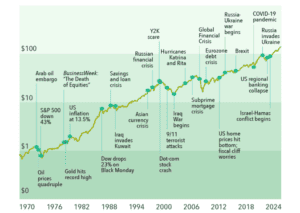
Growth of $1—MSCI World Index (net dividends), 1970-2025. Source: Dimensional
Clearly, market downturns can be uncomfortable, especially if you have a substantial portfolio alongside your retirement funds.
However, it’s important to be aware that periods of market weakness can actually create opportunities to buy stocks at bargain prices, which can potentially enhance your future returns when markets recover.
Expats can face specific challenges during a recession
If you’re an expat, you have additional considerations to keep in mind when reviewing your financial position in light of a potential recession.
The threat of economic uncertainty can often be accentuated by:
- Fluctuations in currency exchange rates
- Potential cross-border tax issues
- Managing your assets in two different jurisdictions.
Ensuring these factors are fully integrated into your financial planning can help you navigate uncertainty more effectively and avoid unintended consequences.
Expert advice can help you ensure your long-term financial plans are robust
As an expat, the most effective response to fears of a serious recession is to focus on the sound financial fundamentals you have read about here, such as maintaining adequate cash reserves, managing your debt carefully, and diversifying your investments.
Perhaps most importantly, the key issue is not to overreact or panic, but to trust your long-term financial plans.
At bdhSterling, we have a wealth of experience in helping clients with their financial planning. With offices and experienced financial planners in both the UK and Australia, we are ideally placed to help expats in both countries with financial planning and ensure you remain on track to meet your long-term financial goals.
Get in touch
If you have concerns about how economic uncertainty could affect you and would like to discuss your see how we can help.
Please note
The value of your investment can go down as well as up, and you may not get back the full amount you invested. Past performance is not a reliable indicator of future performance.
This article is for information only; it does not take into account your personal objectives, financial situation, or needs.
Please do not solely rely on anything you have read in this article and ensure that you conduct your own research to ensure any actions you may take are suitable for your circumstances.
All contents are based on our understanding of HMRC and ATO legislation, which is subject to change.