

The Australian government’s May 2026 Budget introduced the most significant changes to capital gains taxation in more than 30 years.
These changes are likely to affect anyone building long-term wealth outside superannuation.
While the reforms are not due to take effect until 1 July 2027, it is important to understand what is changing, how the new rules could affect you, and whether they should influence your financial planning.
The 50% CGT discount is being replaced with an inflation-based discount
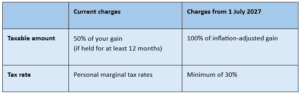
Currently, you can generally receive a 50% Capital Gains Tax (CGT) discount when you hold an asset for at least 12 months. This can apply to investments such as shares and property held outside superannuation.
From 1 July 2027, the government plans to replace this 50% discount with an inflation-adjusted approach. Instead of automatically reducing a qualifying capital gain by 50%, the original price of an asset will be adjusted for inflation, so tax focuses on the real, rather than the notional, gain.
The reforms will also introduce a minimum 30% tax rate on real capital gains.
The timing of your investment decisions matters
The changes are prospective, meaning they do not retrospectively remove the benefit of the existing 50% discount from gains that you accrue before 1 July 2027.
Instead, the existing rules will apply to the portion of a gain accrued up to 30 June 2027, while the new inflation-based arrangements will apply to gains accruing from 1 July 2027.
This means you do not suddenly lose the benefit of the current rules on gains already built up before the change takes effect.
However, gains accruing from 1 July 2027 will be calculated under the new system, which could result in a different tax outcome when an investment is eventually sold.
As a result, the timing of your future investment decisions becomes an increasingly important financial planning consideration.
Property investors could also be affected by the new rules
The Budget also proposes changes to negative gearing for residential property.
Negative gearing occurs when the costs of an investment, such as loan interest, exceed the income it generates. Under the current rules, the resulting loss can generally be offset against other taxable income.
From 1 July 2027, investors who acquired established residential property after the Budget will no longer be able to offset those losses against non-residential income, such as salary.
Instead, they can offset losses against other residential property income and capital gains, with excess losses carried forward.
Properties acquired before the Budget announcement are protected from the changes. Newly built residential property will also retain access to the existing negative-gearing arrangements.
For property investors, therefore, the tax treatment will depend not only on when a property is purchased, but also on whether it is an existing property or a new build.
The impact will depend on your circumstances
If you have a substantial investment portfolio, the difference between the existing and proposed systems could be significant.
For example, if your portfolio cost you AUD $500,000 and you sell it for $800,000, you would currently be liable for a CGT charge of $150,000 on the $300,000 gain.
However, under the proposed new system, the calculation would instead take account of inflation when determining the real gain. Depending on how long you had held the investment and the inflation rate over that period, this could produce a very different result.
This means CGT will no longer be a simple purchase-price-versus-sale-price calculation.
What could this mean for financial planning?
These changes highlight the importance of looking beyond the headline tax rate when making investment decisions.
You will want to review the balance between assets you hold through companies or trusts and those assets held within your super fund that still enjoy favourable tax treatment.
Asset location could also become more important. Rather than simply asking which investment is likely to produce the highest return, you may need to consider where you hold that investment and how the eventual gain will be taxed.
This is particularly relevant as you approach retirement. Your investment strategy may need to evolve as you move from accumulating wealth to drawing an income. Understanding how capital gains interact with other sources of income can therefore form an important part of retirement planning.
Find out more: How changes to Capital Gains Tax could affect you
Don’t let tax drive your investment strategy
The key point is that taxation should be part of your investment strategy, but it should not drive your decisions.
There may be circumstances where realising a gain before or after 1 July 2027 produces a different tax outcome. But selling an asset purely because the rules are changing could leave you with a less diversified portfolio, higher transaction costs, or an investment strategy that no longer matches your objectives.
Instead, consider the changes alongside your investment timeframe, risk tolerance, retirement plans, and wider financial position.
Use the time to review your plan
The period before the new rules take effect allows you to review your overall financial plan, model different scenarios, and consider how the changes could affect future investment and retirement decisions.
The key is not simply to minimise tax, but to understand how the changing tax landscape fits into your wider financial objectives.
Professional financial and tax advice can help you assess the potential impact and decide whether your investment strategy remains appropriate for the future.
Get in touch
If you would like expert guidance or to consider how these changes could affect you, please get in touch with us.
Please note
The value of your investment can go down as well as up, and you may not get back the full amount you invested. Past performance is not a reliable indicator of future performance.
This article is for information only; it does not take into account your personal objectives, financial situation, or needs.
Please do not solely rely on anything you have read in this article and ensure that you conduct your own research and get expert advice to ensure any actions you may take are suitable for your circumstances.
All contents are based on our understanding of HMRC and ATO legislation, which is subject to change.